Free Hydrate On Orders $99+ USE CODE: HYDRATE

Free Hydrate On Orders $99+ USE CODE: HYDRATE

Healthy Energy Drinks: What to Look For (and What to Avoid)
May 12, 2026 8 min read
"Healthy energy drink" gets thrown around a lot. Walk down the energy aisle at any grocery store and you'll see cans claiming "natural," "clean," "zero sugar," and "performance" — most of which fall apart under any real scrutiny of the label.
For blue collar workers drinking energy products five or six days a week for years, the difference between a genuinely healthy energy drink and one that just markets itself that way matters. It's the difference between supporting your body across a long career of physical work and grinding it down one canned drink at a time.
Here's the four-criteria framework for what actually makes an energy drink healthy, what to avoid on the label, and which products meet the standard for daily use.
What Makes an Energy Drink Healthy?
Four criteria separate a real healthy energy drink from one that just calls itself healthy:
1. Zero sugar (or genuinely low sugar). Sugar is the single biggest reason canned energy drinks crash people and contribute to long-term weight gain and metabolic problems. A typical 16 oz canned energy drink contains 40 to 55 grams of sugar — roughly 10 to 14 packets of sugar per drink. Daily consumption at that level is hard on your blood sugar regulation, dental health, and energy stability. A genuinely healthy energy drink has zero sugar or stays under 5 grams per serving.
2. Moderate caffeine, not maxed-out caffeine. The work-safe range for caffeine is 150 to 300 mg per drink. Less than that and you don't feel it. More than that and you cross into jittery territory, anxiety, sleep disruption, and harder crashes. The 400-plus mg territory marketed to gym-goers and gamers is the wrong tool for daily-use across an 8- to 12-hour workday.
3. Real ingredients in real doses. Healthy energy drinks list every ingredient with the actual dose on the panel. They don't hide ingredients inside "proprietary blends" with vague claims. They include the supporting nutrients (B vitamins, amino acids, electrolytes) that your body actually uses to produce sustained energy — not just stimulation alone.
4. Daily-use safety profile. If you're drinking it five days a week for years, it needs to be clean: no banned stimulants, no hormones, no questionable amphetamines, no mystery compounds. Third-party testing matters here. So does manufacturing in an FDA-registered facility. Healthy energy drinks pass a daily-use standard, not just a one-time-okay standard.
A genuinely healthy energy drink hits all four criteria. Anything that fails one is selling stimulation, not health.
Before Work Fuel — Built to Hit All Four Criteria
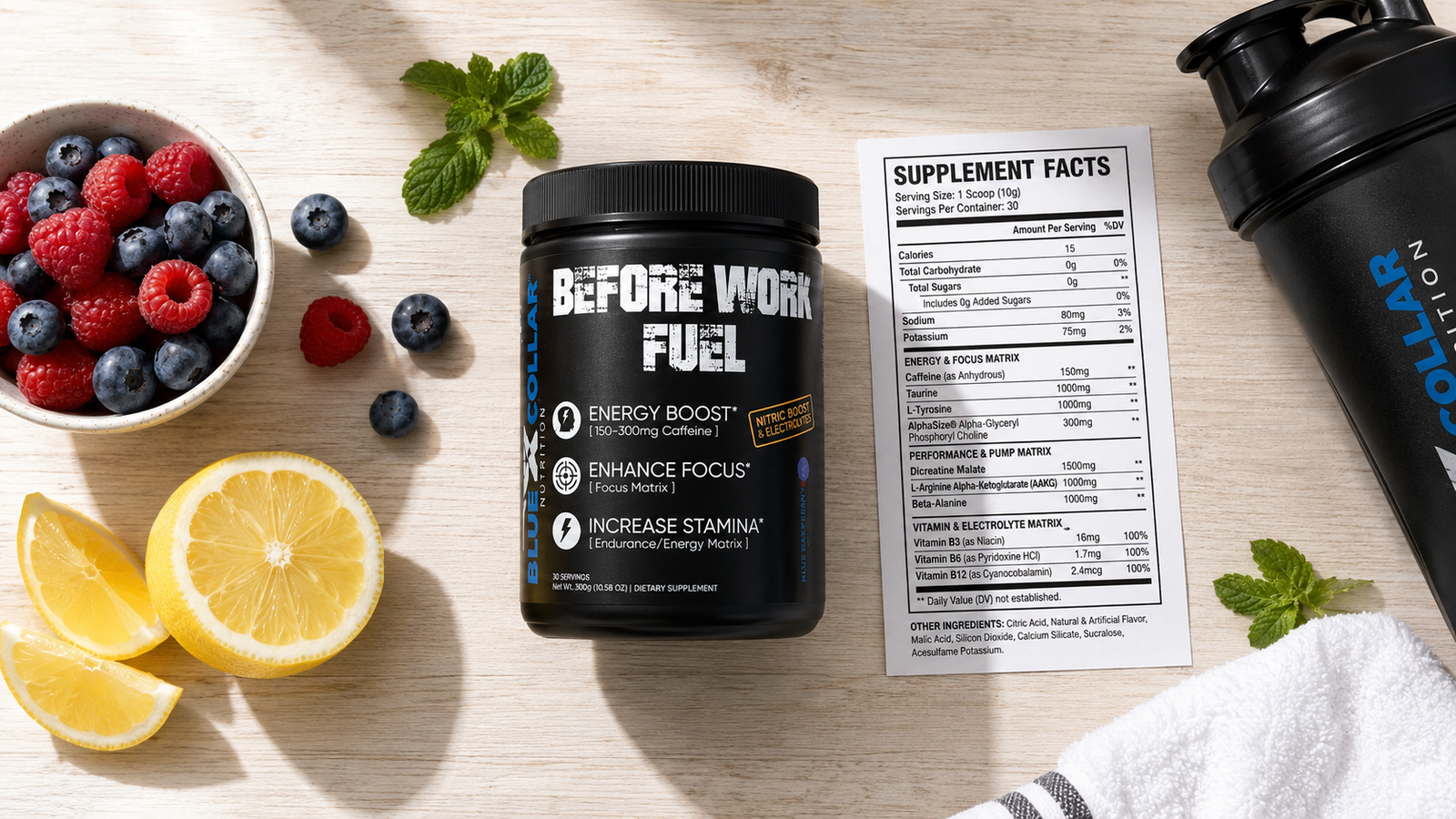
Before Work Fuel was designed specifically around these criteria for blue collar workers running long physical shifts. Here's how it stacks against the framework:
Zero sugar. Sucralose-sweetened, zero grams of sugar per serving. No insulin spike, no blood sugar crash, no daily contribution to dental or metabolic problems.
Moderate caffeine in the work-safe range. 150 mg per scoop, with 1–2 scoops delivering 150–300 mg total. That keeps you inside the work-safe window without crossing into jittery territory.
Real ingredients in real doses, listed on the panel. A full B-vitamin complex (B1, B2, B3, B6, B12, folate, pantothenic acid), focus-supporting amino acids (L-Tyrosine and Taurine in the Focus Matrix), Dicreatine Malate (1,500 mg) and AAKG (1,500 mg) for sustained physical output, plus 80 mg sodium and 75 mg potassium per scoop for real electrolyte support. No proprietary mystery blends hiding doses.
Daily-use safety profile. Hormone-free, no banned stimulants, no anabolic ingredients, no caffeine-stacking compounds beyond the labeled 150 mg per scoop. Third-party tested and made in the USA in an FDA-registered facility.
That four-criteria match isn't accidental — it's what BCN built the formula around. For deeper context on how Before Work Fuel compares to canned options and coffee specifically, see our guide to the best energy drink for work.
What to Avoid on the Label
Here's what disqualifies an energy drink from being genuinely healthy:
High sugar content. Any energy drink with 20+ grams of sugar per serving sets up the spike-and-crash cycle. Common in major canned brands — check the label, not the marketing.
Caffeine over 400 mg per serving. Some high-stim products push 400, 500, or even 600 mg per can. That's gaming/gym-marketing territory, not daily-use territory. Cumulative effects on sleep, anxiety, and cardiovascular load are real concerns.
Proprietary blends with hidden doses. If the label says "Energy Blend: 1,200 mg" without breaking down what's in the blend or at what dose, you have no idea what you're actually drinking. Avoid.
Synthetic stimulants with sketchy safety profiles. DMHA, DMAA (where still found), synephrine in high doses, and other "borderline" stimulants have been pulled from markets in some countries for safety reasons. If you can't easily find safety data on an ingredient, that's a signal.
No electrolytes in physical-work products. If a product markets itself for "performance" or "endurance" but skips sodium and potassium entirely, it wasn't designed for actual physical work. Most canned energy drinks fall into this category.
Vague "natural flavors" plus a wall of color additives. This isn't always disqualifying, but products that emphasize their "clean" marketing while loading up on artificial colors and undisclosed flavor compounds are sending mixed signals.
Powdered vs. Canned: Why Format Matters for Healthy Energy
Beyond ingredients, the format of an energy drink affects how healthy it is for daily use.
Powdered energy drinks generally fit the healthy criteria better than canned options for three reasons:
- Dose control. One scoop for moderate days, two for heavy ones, half a scoop for a mid-shift top-up. You're not locked into whatever's printed on a fixed can size.
- Real ingredients in real doses. The format allows manufacturers to include actually-useful amounts of B vitamins, amino acids, and electrolytes that don't fit in a typical canned formula.
- Cost-effective for daily use. A 30-serving container of Before Work Fuel runs about $1.66 per drink, versus $4 to $6 for a typical canned energy drink. Over a year of daily use, that's $400 instead of $1,500.
Canned energy drinks trade flexibility and ingredient depth for convenience. They're fine for occasional use; for daily workday use, they almost always fall short on the four-criteria framework — usually because of the sugar load.
Is It Safe to Drink Energy Drinks Every Day?
This is where the "daily-use safety profile" criterion matters most. Drinking a high-sugar canned energy drink every workday for years is a real health risk: weight gain, blood sugar dysregulation, dental damage, and cardiovascular load all add up. The "every day" question with that kind of product has a clear answer — no, that's not safe long-term.
Drinking a clean, zero-sugar powdered energy drink with a moderate caffeine dose every workday is a different conversation entirely. It's closer to drinking strong coffee with a multivitamin than to drinking a soda — and millions of healthy adults drink coffee every day without issue.
The factors that determine daily-use safety:
- Total daily caffeine — staying under 400 mg total per day is the standard guideline
- Sugar content — zero or very low is the sustainable choice for daily use
- Ingredient transparency — knowing what's in your drink matters when you're consuming it consistently
- No banned stimulants or hormone-active compounds — non-negotiable for daily use
- Hydration support — daily-use energy products should support, not strip, your body's electrolyte balance
A product that meets all five is sustainable for daily use. A product that fails any of them isn't.
The Daily Energy System for Blue Collar Workers
For workers who use an energy product every workday, the smartest approach is a system rather than a single drink.
Morning fuel: Mix one scoop of Before Work Fuel in 8 to 16 oz cold water 15 to 30 minutes before clock-in.
Mid-shift hydration: Hydrate or Refuel for the back half of the day, especially in heat. Replaces the electrolytes lost across a physical shift.
Post-shift recovery: After Work Recovery or Refuel to support the recovery window that determines how the next morning feels.
For workers running the full daily system, the Workday Pack bundles all three pieces together. For just the morning fuel plus mid-shift hydration, the Overtime Pack combines Before Work Fuel and Refuel for $74.97 — and your first purchase comes with free gifts on top.
For workers regularly running 10- and 12-hour shifts, the deeper read on sustained workday energy lives in our guide to the best energy supplements for long workdays. For workers starting before sunrise, see the best early morning energy drink for blue collar workers.
Frequently Asked Questions
What is the healthiest energy drink?
The healthiest energy drink is one that meets four criteria: zero or very low sugar, moderate caffeine in the 150 to 300 mg range, real ingredients in disclosed doses on the panel, and a clean daily-use safety profile (no banned stimulants, no hormones, third-party tested). Powdered energy drinks generally fit these criteria better than canned options because they allow real doses of supporting ingredients like B vitamins, amino acids, and electrolytes that canned formulas usually skip. Before Work Fuel was built specifically around these four criteria for daily use by blue collar workers.
Are there healthy energy drinks for daily use?
Yes — when they meet the daily-use criteria. The factors that determine whether an energy drink is sustainable for daily consumption are: total caffeine under 400 mg per day across all sources, zero or very low sugar, transparent ingredient labeling, no banned substances, and supporting nutrients (B vitamins, electrolytes) that work with your body across a workday rather than against it. Powdered energy drinks formulated specifically for daily workday use generally meet this bar; high-sugar canned drinks generally don't.
Is it bad to drink energy drinks every day?
It depends entirely on the energy drink. Drinking a high-sugar canned energy drink every day for years is hard on your blood sugar regulation, weight management, dental health, and metabolic function. Drinking a clean, zero-sugar powdered energy drink with moderate caffeine is much closer to drinking daily coffee with a multivitamin — sustainable for healthy adults when used at appropriate doses. The key factors are sugar content, caffeine dose, and the supporting ingredients that make daily use safe versus stressful on the body.
What ingredients should I avoid in energy drinks?
Avoid high sugar content (over 20 grams per serving), caffeine doses over 400 mg per serving, proprietary blends that hide individual ingredient doses, synthetic stimulants with limited safety data (DMHA, high-dose synephrine), and any product missing electrolytes if it's marketed for physical work. Also watch for products that emphasize "clean" or "natural" branding while loading up on artificial colors and undisclosed flavor compounds — the inconsistency is a signal.
What are healthy energy drink alternatives to Red Bull and Monster?
The cleanest alternative to canned energy drinks like Red Bull and Monster is a powdered energy drink with zero sugar, moderate caffeine, real electrolytes, and B-vitamin support. A typical 16 oz canned drink delivers 150 to 300 mg of caffeine paired with 40 to 55 grams of sugar — the sugar is what causes most mid-shift crashes. Switching to a zero-sugar powdered alternative removes the crash mechanism and typically costs about a quarter of what canned drinks cost per serving. For deeper comparison context, see our guide to the best energy drink for work.
Are powdered energy drinks healthier than canned energy drinks?
Generally yes, for three reasons. Powdered formats allow real doses of supporting ingredients (B vitamins, amino acids, electrolytes) that canned drinks usually skip. They give you dose control — you can take less or more depending on the day. And they typically skip the high sugar loads found in most canned options. The result is sustained energy without the crash, hydration support built in, and a cost-per-drink that makes daily use actually affordable.
How much caffeine is safe in a daily energy drink?
The general health-authority guideline is to stay under 400 mg of total caffeine per day for healthy adults, including all sources (coffee, energy drinks, tea, etc.). For a daily energy drink specifically, 150 to 300 mg per serving sits in the work-safe window that supports focus without crossing into jitters, anxiety, or sleep disruption. Workers new to caffeine or sensitive to stimulants should start lower and scale up gradually.
The Bottom Line
"Healthy energy drink" isn't just marketing — when the four criteria are actually met (zero sugar, moderate caffeine, real ingredients in real doses, daily-use safety profile), the product earns the label. When they're not, the marketing is doing the work the formula isn't.
For blue collar workers drinking energy products consistently across long careers of physical work, the difference matters. The fix is checking the label, not the can.
Try Before Work Fuel — built specifically around the four-criteria framework for healthy daily-use energy. Zero sugar, 150–300 mg caffeine, full B-complex, real electrolytes, third-party tested, made in the USA, hormone-free, and backed by a 100% money-back guarantee. Or explore the full Blue Collar Nutrition Energy collection.