Free Hydrate On Orders $99+ USE CODE: HYDRATE

Free Hydrate On Orders $99+ USE CODE: HYDRATE

Energy Drinks for Long Workdays: The Hard Worker's Guide to Picking, Stacking, and Replacing the Gas Station Habit
May 16, 2026 13 min read
If you work a long shift, you've already learned what every gas station energy drink eventually teaches you: caffeine and sugar will get you to lunch, but they won't get you to clock-out. The 3 PM crash hits, the focus drops, and by the time you make it home, you're wrecked.
This guide is for workers who depend on their energy to make a living — tradesmen, drivers, warehouse crews, oilfield workers, mechanics, construction workers, first responders, and anyone running 10 to 12 hour shifts. We'll cover how to pick the right energy drink for long workdays, how to stack products for sustained output, and how to replace the gas station habit with something cleaner and cheaper that actually works.
What Are the Best Energy Drinks for Long Workdays?
The best energy drinks for long workdays share four specific traits:
- Moderate caffeine doses (125-200mg per serving — not 300mg+ stim bombs)
- Zero or low sugar (under 5g per serving — gas station drinks pack 30-40g)
- Real nutrient density (B-vitamins, electrolytes, amino acids — not just flavored caffeine water)
- Recovery support (amino acids or other compounds that work in the background)
By those criteria, the best energy drinks for long workdays are typically powdered formulas mixed fresh, not canned drinks. Powders deliver more ingredients at higher doses, contain less sugar, and cost a fraction of the per-serving price of gas station cans.
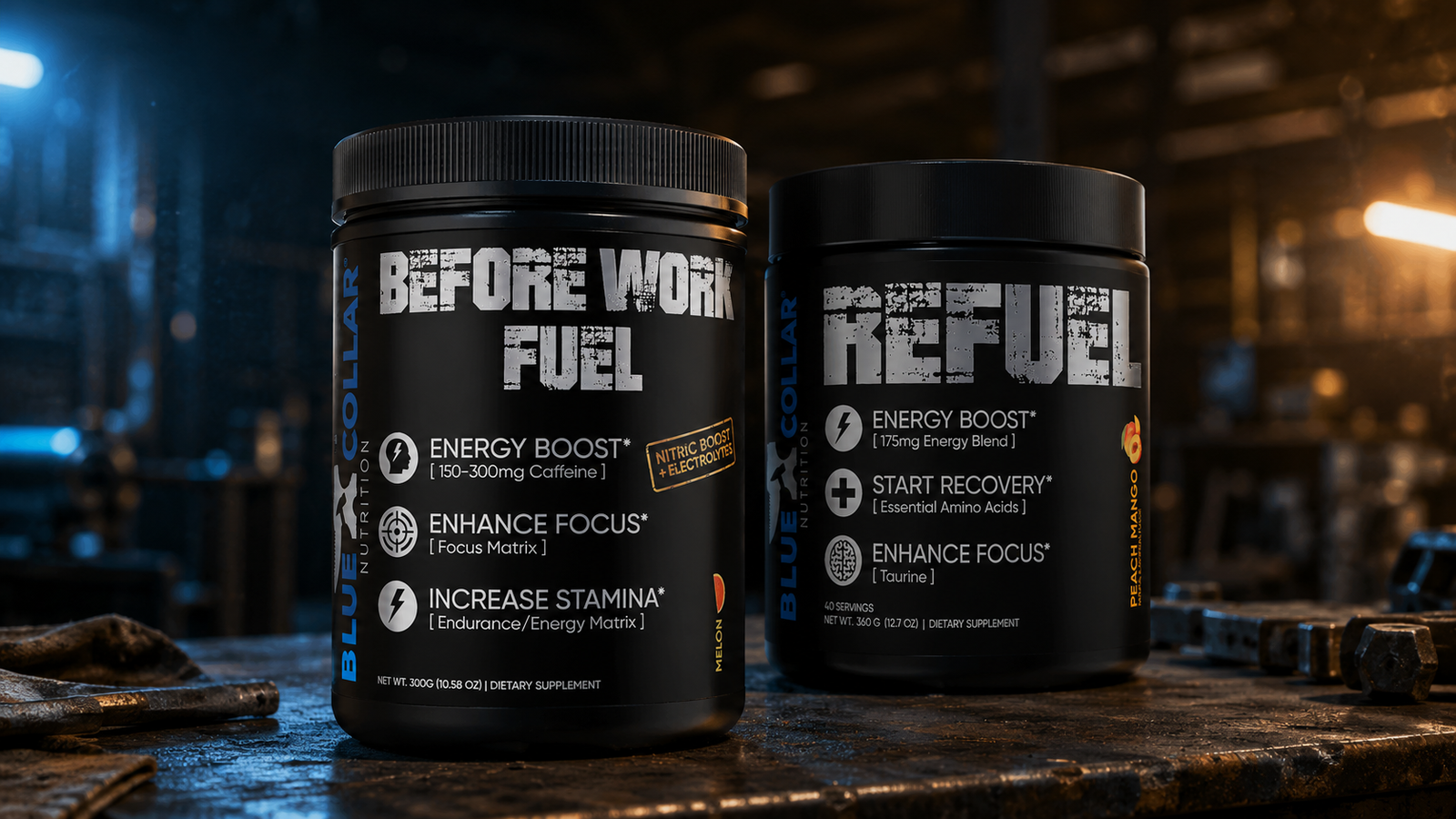
The two products built specifically for this use case are Before Work Fuel (the morning energy powder, 150mg caffeine) and Refuel (the mid-shift amino acid energy powder, 125mg caffeine). Together they deliver sustained energy from clock-in to clock-out at $74.97/month bundled in the Overtime Pack.
How Do I Choose Energy Supplements for Shift Work?
Choosing an energy supplement for shift work comes down to four questions:
1. When does your shift start? Early shifts (4-6 AM start) need fast-acting morning energy with real electrolytes — your body is fighting dehydration and sluggishness at once. Look for a powdered energy drink with caffeine, B-vitamins, and electrolytes mixed fresh.
2. How long is your shift? 8-hour shifts can usually be handled with one morning energy product. 10-12 hour shifts need a two-stage approach: morning energy plus a mid-shift refill. Single-product strategies fail on long shifts because the crash hits before clock-out.
3. How physical is the work? Light-physical jobs (driving, dispatch, monitoring) benefit from cognitive-focused energy with moderate caffeine and ingredients like Tyrosine and B-vitamins. Heavy-physical jobs (trades, construction, oilfield, warehouse) need amino acid recovery support layered on top of the energy — your muscles are working under load all day, and starting recovery during the shift (not after) speeds the bounce-back.
4. Are you running multiple shifts a week with limited recovery time? Workers doing 60-hour weeks or back-to-back doubles need consistent daily nutrient support that builds over weeks. This is where stacking pays off: morning energy + mid-shift amino acid energy + daily cognitive support layered together creates a foundation that holds up across an entire workweek.
For workers running heavy weekly hours, the 60-hour work week survival guide covers structuring rest, hydration, and nutrient timing in more depth.
Compare Energy Supplements for Daily Use and Long Shifts
Here's a direct comparison of the most common energy supplement categories, evaluated for daily use across long shifts:
| Type | Pros | Cons | Best for |
|---|---|---|---|
| Gas station energy drinks | Fast, convenient, available everywhere | High sugar (30-40g), hard crash, no nutrients, $200-300/month habit | Emergency use only |
| Energy shots (2 oz bottles) | Concentrated, portable | Stimulant-heavy, short duration, often artificial | Quick caffeine boost; not a daily solution |
| Powdered energy drinks | Lower cost per serving, more ingredients, zero sugar, mix fresh | Requires water access to mix | Daily workday energy |
| Energy capsules/pills | Compact, no mixing required | Less hydration support, slower absorption | Travel or supplemental use |
| Coffee | Cheap, available, familiar | No nutrients beyond caffeine, doesn't address recovery | Foundation only — not a complete solution |
| Amino acid energy powders | Energy + recovery support in one product, moderate caffeine | Slightly more expensive than basic energy products | Mid-shift and second half of long shifts |
For most workers running long shifts, the strongest daily solution is a combination of a powdered energy drink in the morning (like Before Work Fuel) and an amino acid energy powder mid-shift (like Refuel). The two together cover acute energy needs plus recovery support, with total daily caffeine staying under FDA-recommended limits.
What Products Combine Hydration and Energy Without Crashes?
The crash you feel after a typical energy drink isn't really about caffeine — it's about sugar. A 20oz canned energy drink with 30-40g of sugar drives a glucose spike followed by an insulin response that crashes your blood sugar back below baseline. The result: by 2-3 PM, you feel worse than before you opened the can.
Products that combine hydration and energy without crashes share three traits:
1. Zero or near-zero sugar. Without the sugar spike, there's no insulin crash. Energy stays smooth across hours.
2. Real electrolytes (sodium and potassium). Workers sweating through long physical shifts lose 500-1,500mg of sodium per hour. Replacing these supports both hydration and cellular function. Before Work Fuel provides 80mg sodium and 75mg potassium per scoop; for heavy-sweat shifts, stacking with Hydrate adds another 500mg sodium and 340mg potassium per scoop.
3. Moderate caffeine plus supporting compounds. A clean 125-150mg caffeine dose paired with B-vitamins, amino acids, and electrolytes produces hours of sustained energy without jitters or post-stim crashes.
The cleanest hydration-plus-energy stack for long workdays: Before Work Fuel in the morning, plain water through the morning, Refuel right after lunch, and Hydrate layered in during heavy-sweat conditions. Total caffeine stays under 300mg/day; total nutrient support compounds across the shift instead of crashing in the middle.
Which Drinks Provide Sustained Focus for Long Workdays?
Sustained focus across a 10-12 hour shift requires more than caffeine. The four ingredients that genuinely support workday focus are:
Caffeine (in moderate doses). Boosts alertness for 4-6 hours. Beyond 200-250mg per dose, jitters and anxiety outweigh focus benefits. Both Before Work Fuel (150mg) and Refuel (125mg) sit in the productive range.
B-Vitamins (especially B6, B12, and folate). Support neurotransmitter synthesis and cellular energy production. Most workers running on convenience food are deficient in at least one B-vitamin. Both BCN energy products contain a full B-complex.
Tyrosine. An amino acid that supports dopamine and norepinephrine production, directly affecting focus, motivation, and stress tolerance. Especially useful during long shifts under cognitive load.
Phosphatidylserine and Choline. Brain-specific nutrients that support memory, mental clarity, and cognitive endurance. These are foundational ingredients in Mind Fuel — BCN's non-caffeinated daily brain health supplement that builds with consistent daily use.
For workers with cognitively demanding jobs (heavy equipment operators, dispatchers, electricians, first responders, mechanics doing diagnostic work), stacking Mind Fuel daily under the BWF + Refuel energy lineup creates the most sustained focus across long shifts.
Top Energy Supplements That Actually Work With No Crash
The reason most energy supplements crash is one of three things: too much sugar, too much caffeine, or no recovery support to carry you through the back half of the shift.
The energy supplements that actually work without crashing combine:
- Caffeine in the 125-200mg range (not 300mg+ stim bombs)
- Zero added sugar (eliminates the glucose-insulin crash cycle)
- B-vitamins and electrolytes (cellular and hydration support)
- Amino acids (in mid-shift products — supports recovery during the workday)
Three specific products that meet all four criteria:
For morning energy: Before Work Fuel — 150mg caffeine, full B-complex, real electrolytes, amino acid focus matrix, zero sugar. Mix with cold water 15-30 minutes before clock-in.
For mid-shift energy: Refuel — 125mg caffeine in a 175mg Energy Blend (with Theobromine and Green Tea Extract), 5,000mg Amino Blend with all 9 essential amino acids, zero sugar. Mix right after lunch.
For cognitive support beneath the energy lineup: Mind Fuel — non-caffeinated daily brain health supplement with 23 active ingredients including Bacopa, DMAE, Choline, and Phosphatidylserine. Builds over 2-4 weeks of consistent daily use.
For the complete two-stage system at the lowest price, the Overtime Pack bundles Before Work Fuel and Refuel together for $74.97 — $93.97 less than buying them separately, plus over $35 in free first-order gifts.
Best Energy Drinks for Physical Labor
Workers doing heavy physical labor have specific energy needs that differ from desk workers or recreational gym-goers. Physical labor workers need:
Higher electrolyte content to replace sodium and potassium lost in sweat across 8-12 hour shifts in challenging conditions.
Amino acid support during the shift — not just after. Muscle protein breakdown begins within hours of physical work; providing amino acids during the shift starts recovery while you're still on the job, reducing soreness and accelerating bounce-back between days.
Sustained caffeine release over hours rather than spike-and-crash patterns. Moderate caffeine doses (125-150mg) paired with food and electrolytes produce smoother energy curves than concentrated 300mg+ doses.
Zero sugar — physical workers can't afford the mid-shift crash that sugar drives.
For physical laborers, the strongest two-product daily lineup is Before Work Fuel in the morning + Refuel mid-shift. The amino blend in Refuel (5,000mg of all 9 EAAs plus Glutamine, Citrulline, and Theanine) starts supporting muscle recovery while you're still working — the difference between feeling wrecked at clock-out and feeling reasonably intact.
For comprehensive coverage of how to structure energy and recovery across a physically demanding workweek, see Best Energy Supplements for Long Workdays: No Crash, All Day — the cluster anchor on this topic.
How to Stack Energy Products for a Long Workday
Stacking energy products for a long workday means timing different products to deliver continuous support across the shift. The most effective approach for hard workers is the two-stage stack:
Stage 1: Pre-shift (15-30 minutes before clock-in)
Mix one scoop of Before Work Fuel with 8-16 oz of cold water. Drink it on your way to work or as you're getting ready. This delivers:
- 150mg caffeine peaking around hour 1-2 into the shift
- 80mg sodium and 75mg potassium for early-shift hydration
- Full B-complex for cellular energy production
- Amino acid focus matrix (Tyrosine, Taurine, Betaine, Citrulline) for focus and circulation
This carries you through the morning. Drink water consistently — aim for at least 24oz between Stage 1 and lunch.
Stage 2: Mid-shift (right after lunch)
Mix one scoop of Refuel with 8-16 oz of water. Drink it immediately after eating lunch — the food helps absorption and prevents the moderate caffeine from hitting an empty stomach. This delivers:
- 125mg moderate caffeine (peaking in the afternoon when most workers crash)
- 5,000mg Amino Blend with all 9 EAAs for muscle recovery during the back half of the shift
- Theobromine and Green Tea Extract for smoother stimulation
- Zero sugar, 30 calories per scoop
The Refuel scoop is the critical move. While your coworkers crash at 2-3 PM, you stay productive — and the amino acids in your system are supporting recovery while you're still working, not waiting until you clock out.
Optional Stage 3: Daily foundation
For workers wanting maximum sustained focus across consecutive long shifts, layer Mind Fuel at breakfast every day. Two capsules with food, taken daily. Mind Fuel is non-caffeinated and builds with consistency — most workers notice the cognitive impact starting around week 2-3 of daily use.
Total Daily Caffeine With the Stack
- Before Work Fuel: 150mg
- Refuel: 125mg
- Mind Fuel: 0mg
- Total: 275mg (well under the 400mg FDA daily safe limit)
For workers also drinking coffee, the BWF + Refuel system stays within safe limits even with a morning cup. Two cups of coffee plus the stack is the upper edge — track caffeine if you're sensitive.
How to Replace Gas Station Energy Drinks for Good
The hardest part of quitting gas station energy drinks isn't quitting caffeine — it's breaking the daily routine. The 5 AM stop. The mid-day reach. The conditioned habit of pulling open a cooler door every time you need to function.
The cleanest replacement strategy is to substitute the routine, not eliminate it:
Week 1: Replace the morning gas station drink with Before Work Fuel mixed fresh at home or in the truck. Same caffeine, way more nutrients, fraction of the cost. Don't try to change the afternoon habit yet.
Week 2: Add Refuel after lunch as the second-shift drink. Now both your gas station stops are replaced. Total caffeine stays moderate; total cost is a fraction of two cans a day.
Week 3: Notice the difference. Less crash. Less brain fog. Steadier energy. By now most workers have stopped reaching for cans automatically — the gas station habit is broken because the routine has been replaced.
Month 2: Track your savings. Two energy drinks a day at $4 each is $240/month. The Overtime Pack on Subscribe and Save costs $74.97/month and delivers about 60 servings. You're saving $165/month — $1,980/year.
The math works. The body works better. And you're done getting up early to drive to a cooler.
Why Some Energy Drinks Make You Crash Hard
The crash from gas station energy drinks comes from three overlapping mechanisms:
1. The sugar response. 30-40g of sugar in a typical canned energy drink drives a glucose spike, triggering an insulin response that crashes blood sugar back below baseline. The fatigue you feel 2-3 hours after drinking it is partly low blood sugar.
2. The caffeine peak-and-fall. High-dose caffeine (200-300mg in a single can) peaks fast and falls hard. Without supporting compounds (food, B-vitamins, amino acids), the drop hits you as drowsiness and reduced focus.
3. Adenosine rebound. Caffeine blocks adenosine receptors temporarily; when the caffeine clears, the accumulated adenosine floods the system at once, producing strong fatigue. Lower, sustained doses (125-150mg) produce a smoother curve than 300mg+ spikes.
The way to avoid the crash is to pair moderate caffeine with food, eliminate the sugar entirely, and provide supporting nutrients (B-vitamins, electrolytes, amino acids) that work in the background. Both Before Work Fuel and Refuel are formulated specifically around this principle.
For deeper coverage of why work-day energy drinks cause crashes and what to look for in a crash-free alternative, see Why Some Work Energy Drinks Make You Crash Hard.
Which Brands Make Trusted Energy Formulas for Hard Workers?
Most energy drink brands target one of three audiences: gym/fitness, gamers/students, or general convenience-store shoppers. Few are formulated specifically for workers running 10-12 hour physical shifts.
The criteria for a trusted worker-focused energy brand:
- Moderate, transparent caffeine doses (not stim bombs)
- Zero added sugar in the energy products
- Real nutrient density (B-vitamins, electrolytes, amino acids)
- Made in the USA, third-party tested, hormone-free
- Drug-test safe for employment, military, and athletic screens
- Designed for daily use at affordable per-serving prices
Blue Collar Nutrition's Energy collection is built specifically against these criteria — every product in the lineup (BWF, Refuel, Mind Fuel, Overtime Pack) is formulated for workers who depend on their energy and focus to make a living, with manufacturing standards and ingredient transparency built for daily use across long careers.
Frequently Asked Questions
What are the best energy drinks for long workdays?
The best energy drinks for long workdays are powdered formulas with moderate caffeine (125-200mg per serving), zero added sugar, and real nutrient density (B-vitamins, electrolytes, amino acids). For hard workers, the strongest daily lineup is Before Work Fuel in the morning (150mg caffeine, electrolytes, B-complex) and Refuel mid-shift (125mg caffeine, 5,000mg amino blend for recovery). Together they cover sustained energy from clock-in to clock-out, and bundle in the Overtime Pack for $74.97 total.
How do I choose energy supplements for shift work?
Choose energy supplements for shift work based on shift length, physical demand, and shift consistency. Short shifts (under 8 hours) can be handled with a single morning product. Long shifts (10-12 hours) require a two-stage approach: a morning energy product plus a mid-shift refill with amino acid support. Heavy physical work benefits from amino acid recovery support; cognitive work benefits from focus-targeted ingredients like Tyrosine, B-vitamins, and Phosphatidylserine. Workers running 60-hour weeks should also add a daily non-caffeinated cognitive support product like Mind Fuel to build foundation over weeks.
Do energy drinks make you crash?
Most gas station and convenience-store energy drinks cause crashes due to high sugar content (30-40g per can drives a glucose-insulin crash cycle), excessive caffeine peaks (300mg+ doses fall hard), and lack of supporting nutrients. Properly formulated energy supplements with moderate caffeine (125-200mg), zero added sugar, and B-vitamins/electrolytes/amino acids produce smooth, sustained energy without the crash. Both Before Work Fuel and Refuel are formulated to avoid the crash cycle.
Do energy drinks make you gain weight?
Gas station and convenience-store energy drinks can contribute to weight gain primarily due to sugar content — a typical 20oz can contains 30-40g of sugar (160 calories). Drinking 1-2 cans a day adds 320-640 calories of pure sugar to your daily intake. Zero-sugar powdered energy drinks like Before Work Fuel (zero calories) and Refuel (30 calories per scoop) avoid this issue entirely. For deeper coverage, see Do Zero Calorie Energy Drinks Cause Weight Gain?.
Can I take an energy drink every day for work?
Yes, with two conditions: total daily caffeine stays under 400mg (FDA's recommended safe limit for healthy adults), and the energy product is formulated for daily use — meaning moderate caffeine, zero sugar, and real nutrient support. Both Before Work Fuel (150mg caffeine) and Refuel (125mg caffeine) are formulated for daily workday use. Taken together at one scoop each, total caffeine is 275mg — safely under the limit even with a morning cup of coffee.
What can I drink instead of energy drinks at work?
The cleanest replacements for canned energy drinks at work are powdered energy formulas mixed fresh with water. Before Work Fuel replaces the morning energy drink with 150mg caffeine, real electrolytes, B-complex, and amino acids — zero sugar. Refuel replaces the afternoon drink with 125mg caffeine plus a 5,000mg amino blend for recovery support. The Overtime Pack bundles both for $74.97 — typically replacing $200-300/month of gas station energy drink spending.
Are powdered energy drinks better than canned?
For daily workday use, powdered energy drinks generally outperform canned drinks in four areas: lower cost per serving (typically $1-2 vs. $4 for canned), higher ingredient density (more compounds at higher doses), zero added sugar in most formulas, and better portability via pre-loaded travel funnels. Canned drinks have the advantage of convenience — they require no mixing — but the price, ingredient quality, and sugar content make them inferior for daily use. Powdered formulas like Before Work Fuel are the dominant choice for workers running long daily shifts.
How much caffeine should I have during a long workday?
The FDA recommends a daily caffeine intake of no more than 400mg for healthy adults. For most hard workers running long shifts, the practical sweet spot is 200-350mg spread across two doses: a morning dose (150-200mg) for shift start, plus a mid-shift dose (100-150mg) for the afternoon. Stacking Before Work Fuel (150mg) and Refuel (125mg) hits 275mg total daily caffeine — under the FDA limit even with a morning cup of coffee.
Is there an energy drink that won't show up on a drug test?
Yes. Many quality energy supplements are formulated without banned substances and are safe for drug-tested employment, military service, and athletic competition. Every Blue Collar Nutrition product — including Before Work Fuel, Refuel, Mind Fuel, and the Overtime Pack — is hormone-free, contains no amphetamines, and contains no substances banned by employment screens, military regulations, or athletic governing bodies. Always check the specific product label for your situation.
What's the difference between energy drinks for working out and energy drinks for long workdays?
Energy drinks built for working out are typically formulated for 60-90 minute training sessions: high caffeine doses (200-300mg+), aggressive stimulants, and ingredients designed for short, intense bursts. Energy drinks for long workdays require the opposite profile: moderate caffeine doses (125-200mg) that don't peak too hard or fall too fast, sustained energy compounds, real electrolytes for sweat replacement across 10-12 hours, and amino acid support for recovery during the shift. Before Work Fuel and Refuel are formulated specifically for the long-shift profile, not the workout profile.
The Bottom Line
Energy drinks for long workdays don't have to mean a $4 can from a gas station cooler followed by a 3 PM crash. The cleaner alternative is a two-stage powdered system: morning energy for the first half of the shift, amino acid energy for the back half, with daily cognitive support layered underneath for workers running consecutive long days.
For most hard workers, the math is simple. The Overtime Pack bundles Before Work Fuel and Refuel for $74.97/month on Subscribe and Save — replacing $200-300/month of gas station drinks while delivering more nutrients, zero sugar, and recovery support that compounds across the workweek.
Stop renting energy from the gas station. Build a system that actually fits a long workday.
Browse the full Energy collection or start with the Overtime Pack — the cheaper alternative to two energy drinks a day.