Free Hydrate On Orders $99+ USE CODE: HYDRATE

Free Hydrate On Orders $99+ USE CODE: HYDRATE

Clean Energy Drinks: How to Read the Label and Spot the Real Ones
May 12, 2026 9 min read
"Clean" is one of the most overused words in the energy drink aisle. Almost every can on the shelf claims it. Almost none of them actually back it up with the label.
Walk through any grocery store and you'll see "clean energy" written across cans loaded with proprietary blends, artificial colors, undisclosed flavor compounds, and stimulants you've never heard of. The marketing has gotten so loose that the word "clean" carries no information by itself — which is exactly the problem.
For blue collar workers drinking energy products consistently, knowing how to actually read the label matters more than knowing how to read the marketing. Here's what makes an energy drink genuinely clean, how to spot the real ones, and what to avoid in the ingredients list.
What Does "Clean" Actually Mean on an Energy Drink Label?
There's no FDA definition of "clean energy drink." The term emerged from the broader "clean label" movement in food and supplements, where companies use the word to suggest simpler, more transparent formulas. In practice, when a brand says "clean," they're usually claiming some combination of:
- Fewer artificial additives
- No hidden proprietary blends
- Transparent ingredient sourcing
- No banned or questionable stimulants
- Recognizable ingredient names
The problem: every brand defines "clean" differently, and there's no regulatory backing to any of it. A drink can be marketed as "clean" while still containing artificial dyes, hidden caffeine amounts inside a "blend," and stimulants with limited safety data. The word is doing the marketing work, not the formula.
A genuinely clean energy drink earns the label four specific ways:
- Every ingredient listed at its full dose — no proprietary blends that hide individual amounts
- No artificial dyes or controversial color additives
- No stimulants beyond standard caffeine — no DMHA, no DMAA, no synephrine at unverified doses
- Third-party tested to verify what's actually in the product matches what's on the label
When all four are met, "clean" stops being marketing and starts meaning something.
Before Work Fuel — A Clean Label Energy Drink
Before Work Fuel was built specifically around the clean-label criteria. Here's how the formula stacks against the four standards:
Every ingredient listed at its full dose. Caffeine: 150 mg per scoop, listed clearly. Dicreatine Malate: 1,500 mg. L-Arginine Alpha-Ketoglutarate (AAKG): 1,500 mg. Beta-Alanine: 750 mg. Every vitamin and mineral with its exact milligram amount. The only proprietary blend on the label is the 550 mg Energy/Endurance/Focus Matrix, and even that lists every ingredient inside it (L-Taurine, Betaine Anhydrous, Waxy Maize, L-Citrulline Malate, Glycocyamine, Glucuronolactone, L-Tyrosine) — just without breaking down the individual sub-doses, which is standard practice in the supplement industry.
No artificial dyes. The formula uses no artificial colors — no Red 40, no Yellow 5, no Blue 1.
Standard caffeine only. 150 mg of caffeine per scoop is the only stimulant in the formula. No DMHA, no DMAA, no synephrine, no hidden caffeine-stacking compounds.
Third-party tested. Every batch of Before Work Fuel is third-party tested for purity and label accuracy, manufactured in an FDA-registered facility in the USA.
That matches the clean-label criteria across the board. For deeper context on what makes a good work-grade energy product, see our guide to the best energy drink for work.
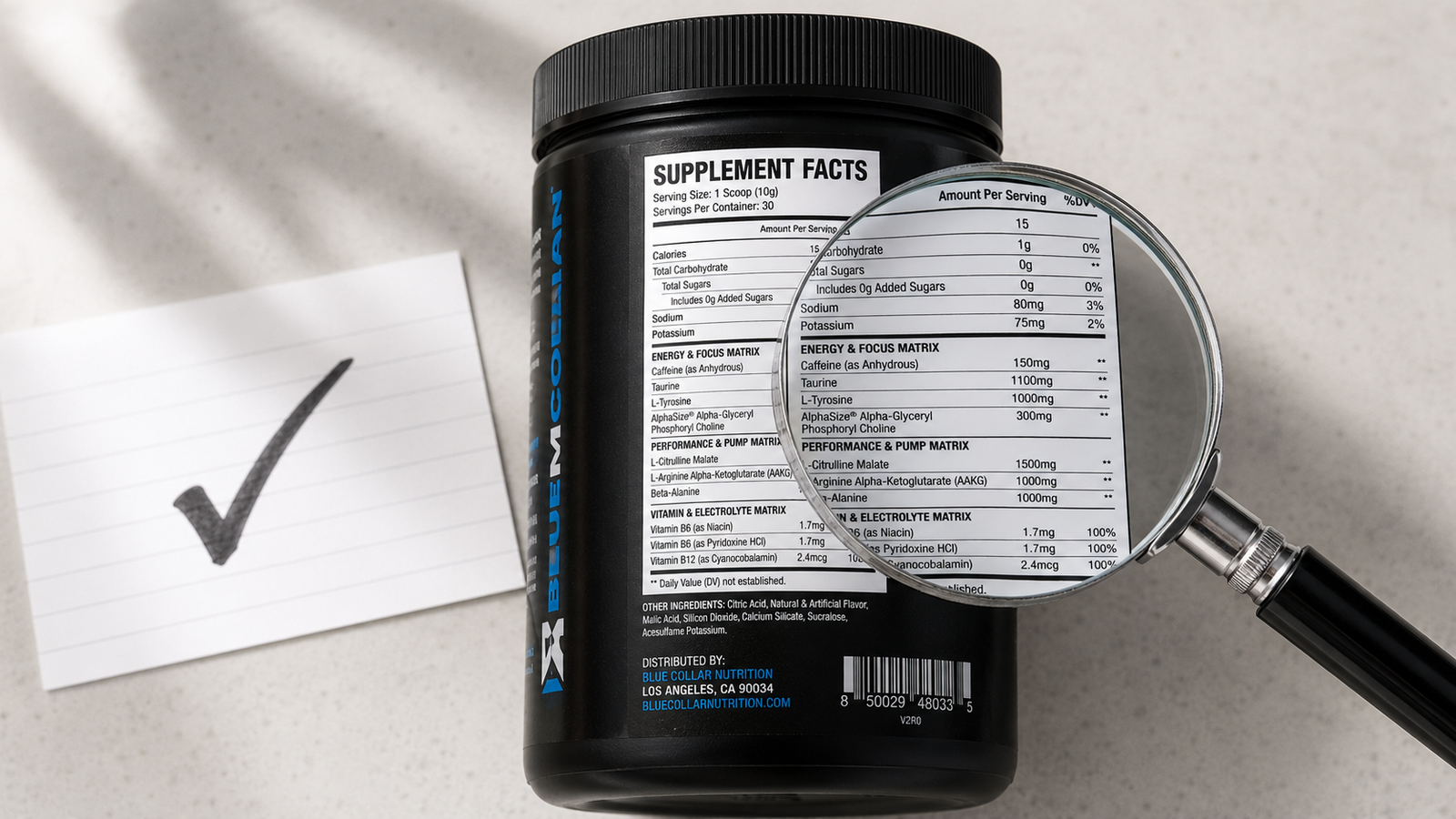
How to Read an Energy Drink Label
Most workers buy energy drinks based on the front of the can. The actual story is on the back. Here's how to read it:
Step 1: Find the Supplement Facts or Nutrition Facts panel. Energy drinks classified as beverages have a Nutrition Facts panel. Those classified as supplements have a Supplement Facts panel. The format is slightly different but both list the active ingredients and doses.
Step 2: Check the caffeine amount. Federal labeling requires caffeine to be listed if it's added to the product. Look for it on the active ingredients list. If you can't find a specific number, the product may be hiding caffeine inside a proprietary blend — that's a red flag.
Step 3: Check for sugar in the Nutrition Facts. Genuine clean energy drinks have zero grams of sugar or stay under 5 grams per serving. Anything 20+ grams is fundamentally not a clean formula regardless of marketing.
Step 4: Read every ingredient in the active blend. If there's a "proprietary blend" or "matrix," check whether the ingredients inside the blend are at least listed individually. Some products list the blend total (e.g., "Energy Blend: 1,200 mg") without naming what's inside. That's the strictest red flag — you literally don't know what you're drinking.
Step 5: Scan the "Other Ingredients" line. This is where artificial colors, flavor compounds, and additives are listed. Look for Red 40, Yellow 5, Blue 1, and other FD&C colors. Look for unfamiliar preservatives. The shorter and more recognizable this list is, the cleaner the formula tends to be.
Step 6: Check for third-party testing or manufacturing certifications. Look for "Made in an FDA-registered facility," "Third-party tested," "GMP certified," or similar callouts. These don't guarantee a clean formula, but they're signals that the manufacturer is operating at a higher standard.
If you run an energy drink through those six steps, you'll know more about what's in it than 99% of buyers do.
What to Avoid in a Clean Energy Drink
Six specific things disqualify an energy drink from being genuinely clean:
Hidden proprietary blends. Any product that uses "Proprietary Blend: X mg" without listing the ingredients inside is hiding information. Common in cheaper or older formulations.
High sugar content. 20+ grams of sugar per serving fundamentally contradicts "clean" — sugar at that level produces metabolic effects no amount of marketing can offset.
DMHA, DMAA, or unlisted stimulants. These compounds have been pulled from markets in some countries for safety reasons. If you can't find safety data on a stimulant in the formula, that's a signal.
Artificial color additives. Red 40, Yellow 5, Blue 1, and similar FD&C colors. Not always disqualifying (the actual safety data is debated), but their presence contradicts "clean" branding almost by definition.
Synephrine at high doses. Synephrine appears in some "natural" energy products marketed as alternatives to ephedrine. The safety data at high doses is mixed; conservative cleanliness standards avoid it.
"Natural flavors" as the only flavor source with no other detail. This isn't disqualifying on its own — "natural flavors" is a legal labeling category that covers a wide range of compounds. But when a product brands as "clean" while leaning heavily on undisclosed flavor compounds, the marketing-vs-formula gap is worth noticing.
Powdered Energy Drinks and the Clean Label Question
Powdered energy drinks generally fit the clean-label criteria better than canned options for one specific reason: the format allows real doses of active ingredients without forcing high sugar or artificial flavoring to make them palatable.
A canned energy drink has to taste good carbonated, in a fixed liquid volume, with the active ingredients pre-dissolved. That formulation pressure often leads to higher sugar content (for taste), more artificial flavoring (to mask off-tastes), and more preservatives (for shelf stability).
A powdered energy drink is mixed cold in water at the point of use. The format doesn't require sugar to taste decent — sucralose or stevia in tiny amounts handle sweetening. There's no carbonation to mask, no shelf-stability issue for liquid mixtures, and no fixed serving size limiting how much active ingredient can be included.
The result is that powdered energy drinks like Before Work Fuel can deliver:
- Real doses of active ingredients (1,500 mg AAKG, 1,500 mg Dicreatine Malate, full B-complex)
- Zero sugar
- Minimal artificial additives
- Real electrolytes (80 mg sodium, 75 mg potassium per scoop)
— all in one scoop, at a cost that makes daily use affordable. Canned options can't match that formulation latitude.
How Clean Energy Drinks Fit Into a Workday System
For workers drinking energy products across long shifts, the clean-label question isn't theoretical. It's about what you're putting into your body 250+ days a year.
Morning fuel: Mix one scoop of Before Work Fuel with 8 to 16 oz of cold water 15 to 30 minutes before clock-in. 150 mg caffeine, full B-complex, real electrolytes, zero sugar, third-party tested.
Mid-shift hydration: Hydrate or Refuel for the back half of the day. Real electrolyte replacement for long, physical shifts.
Post-shift recovery: After Work Recovery to support the recovery window between shifts.
For workers running the full daily system, the Workday Pack bundles all three pieces. For the morning fuel plus mid-shift hydration only, the Overtime Pack combines Before Work Fuel and Refuel for $74.97 — and your first purchase comes with free gifts on top.
For broader context on what makes an energy drink genuinely healthy beyond just clean ingredients, see our guide to healthy energy drinks and what to look for.
Frequently Asked Questions
What is a clean energy drink?
A clean energy drink is one with full ingredient transparency (every active ingredient listed at its specific dose), no hidden proprietary blends, no artificial dyes or controversial color additives, no stimulants beyond standard caffeine, and ideally third-party testing to verify label accuracy. There's no FDA definition of "clean," so the term carries no regulatory weight — which is why reading the actual label matters more than reading the marketing. A genuinely clean energy drink earns the label through the formula, not the marketing copy on the can.
Are there really clean energy drinks?
Yes, but they're less common than the marketing would suggest. Most canned energy drinks claiming to be "clean" still contain some combination of high sugar, artificial dyes, or proprietary blends that hide ingredient doses. Powdered energy drinks generally fit the clean-label criteria better because the format allows real doses of active ingredients without requiring sugar or heavy artificial flavoring to mask the taste. Before Work Fuel is built specifically around the clean-label criteria for daily use by blue collar workers.
How can I tell if an energy drink is actually clean?
Read six things on the label: the caffeine amount (it should be listed specifically, not hidden in a blend), the sugar amount (zero or under 5 grams ideally), the active ingredient blend (every ingredient inside should be named, even if sub-doses aren't always broken down), the "Other Ingredients" line (look for artificial colors like Red 40 or Yellow 5), the stimulant profile (no DMHA, DMAA, or high-dose synephrine), and any third-party testing or manufacturing certifications. If a product passes all six checks, it's genuinely clean. If it fails any of them, the marketing is doing more work than the formula.
Are clean energy drinks safe to drink every day?
When the four clean-label criteria are met (transparent ingredients, no artificial dyes, no questionable stimulants, third-party tested), a clean energy drink with moderate caffeine in the 150 to 300 mg range is generally safe for daily use by healthy adults. The factors that determine daily-use safety are: total caffeine under 400 mg per day across all sources, low or zero sugar, no banned substances, and supporting nutrients (B vitamins, electrolytes) that work with your body rather than just stimulating it. As with any supplement, people with existing medical conditions or taking prescription medications should consult their doctor.
What's the difference between clean energy drinks and natural energy drinks?
"Clean" generally refers to ingredient transparency and the absence of artificial additives. "Natural" specifically refers to ingredients derived from natural sources rather than synthesized. The terms overlap but aren't identical. A clean energy drink can include synthetic ingredients that are still safe and well-studied (like synthetic B vitamins, which are chemically identical to natural ones). A natural energy drink emphasizes the origin of the ingredients more than the transparency of the label. Both terms carry no FDA regulatory weight, so reading the actual label remains the only reliable way to evaluate either claim.
Why don't most canned energy drinks have clean labels?
Three reasons. First, the canned format requires sugar or heavy artificial sweetening to mask the taste of carbonated active ingredients, which conflicts with clean-label principles. Second, the fixed serving size of a can limits how much active ingredient can be included, which encourages manufacturers to use cheaper proprietary blends instead of named, dosed ingredients. Third, the cost pressure of mass-market canned products often leads to artificial dyes and preservatives that wouldn't be necessary in a powdered format. Powdered energy drinks face none of those constraints, which is why genuinely clean energy drinks are more often found in powder form.
What ingredients should never be in a clean energy drink?
DMHA, DMAA (where still found), high-dose synephrine, hidden proprietary blends without ingredient breakdowns, artificial dyes (Red 40, Yellow 5, Blue 1), high sugar content (20+ grams per serving), and any stimulant with limited safety data or banned status in major markets. Also watch for products that emphasize "clean" branding while loading up on undisclosed "natural flavor" compounds — the inconsistency between branding and formulation is itself a signal.
The Bottom Line
"Clean energy drink" only means something when the formula backs it up. The marketing word is meaningless on its own — what matters is what's listed on the label and what's left off it.
For blue collar workers consuming energy products consistently, the difference between marketing-clean and actually-clean is the difference between supporting your body across a long career and quietly grinding it down with hidden additives and questionable stimulants. The fix is reading the label, not the can.
Try Before Work Fuel — built around the clean-label criteria for daily-use by blue collar workers. Zero sugar, no artificial dyes, full ingredient transparency, third-party tested, made in the USA, hormone-free, and backed by a 100% money-back guarantee. Or explore the full Blue Collar Nutrition Energy collection.