Free Hydrate On Orders $99+ USE CODE: HYDRATE

Free Hydrate On Orders $99+ USE CODE: HYDRATE

Best Energy Drink for Work: What to Drink Before a Long Shift
May 12, 2026 9 min read
If you work a physical job, you've probably already done the math. A canned energy drink at the gas station runs $4–6. Times five or six work days a week, times fifty weeks a year, you're looking at $1,000 to $1,800 annually on drinks that crash you by 10 AM and tear up your stomach over time.
The question isn't whether to drink something before work. If you're up at 4:30 AM and on the clock by 6, you're going to drink something. The real question is what's actually worth the money — what holds up across a 10-, 12-, or 14-hour shift without spiking you, crashing you, or wrecking your gut in the process.
This is the practical answer to "what's the best energy drink for work" — what to look for, what to avoid, and what the daily math actually looks like for blue collar workers.
What makes a good energy drink for work
A good energy drink for work isn't the same thing as a good energy drink for a gaming session or a college all-nighter. The job is different. You're operating equipment, working with crews, climbing ladders, driving heavy vehicles, and you need to be sharp from clock-in to clock-out — not jacked up for the first hour and dead by the third.
Four things separate a real work-grade energy drink from the stuff lining the gas station cooler:
Moderate caffeine, not maxed-out caffeine. The sweet spot for physical work is 150–300mg per drink. Less than that and you don't feel it. More than that and you cross into jittery, over-amped territory that makes precision work harder, not easier. The 400mg-plus stim products marketed to gym-goers and gamers are the wrong tool for an eight-hour shift on a job site.
Zero sugar. Sugar is the single biggest reason people crash mid-shift. A canned energy drink with 40–55 grams of sugar spikes your blood sugar fast, then drops it just as fast, and you feel that drop as the wall that hits around 10 or 11 AM. Clean energy without the sugar load doesn't have that crash mechanism built in.
Electrolytes. Most energy drinks deliver caffeine and skip the minerals your body actually needs across a long shift in the heat. Sodium and potassium aren't fancy — they're what keeps you functional when you're sweating through a t-shirt by 9 AM. A work-grade energy product builds them in.
A daily-use safety profile. If you're going to drink something five or six days a week for years, it needs to be clean. That means no banned substances, no hidden hormones, no proprietary blends with mystery doses, and third-party testing. The safest energy drinks for daily use are the ones where every ingredient and every dose is printed on the panel.
Why canned energy drinks fail the work test
Canned energy drinks weren't designed for work. They were designed for short-burst energy — a quick lift during a study session or a workout, marketed for moments, not for shifts.
That's why they fall apart on a job site.
The sugar crash mechanism. When you pound 40–55 grams of sugar in one drink, your blood sugar spikes, your body floods insulin to compensate, and you crash. That's the 10 AM wall most workers know intimately. It's not the caffeine wearing off — it's the sugar dump catching up to you.
The acid problem. Carbonated, acidic drinks on an empty stomach at 5 AM is a setup for heartburn, reflux, and gut issues that compound over the years. Workers who've been drinking three cans a day for a decade know what that does to the digestive system.
The cost math. Five drinks a week at $5 a drink is $1,300 a year. Six drinks a week is $1,560. Over a decade of work, that's $13,000–15,000 spent on caffeinated sugar water that you knew wasn't great for you in the first place.
The hydration paradox. Caffeine has a mild diuretic effect, and canned energy drinks pair it with no real electrolytes — so you end up more dehydrated than when you started. By the time your shift hits hour eight, you're running on fumes because your body chemistry is worse off than it was at clock-in.
Is coffee enough?
For a short shift or a moderate workload, coffee can be enough. A cup of black coffee delivers 80–100mg of caffeine with no sugar and minimal calories, and millions of workers have built careers on it. There's nothing wrong with coffee.
But coffee on its own is a one-trick pony — it's caffeine in, caffeine out. No B vitamins. No electrolytes. No amino acids. No support for the back half of a long shift when caffeine alone stops cutting it.
Coffee also has practical limits. The $5 daily Starbucks habit adds up the same way the energy drink habit does — $1,200–1,500 a year. Cold coffee from a thermos works fine until it doesn't, and gas station coffee is hit or miss.
Coffee's a fine baseline. For long physical shifts, it's not the whole answer.
The powdered energy drink alternative
Powdered energy drinks fix most of what's wrong with cans and most of what's missing from coffee.
You control the dose. One scoop for a moderate day, two scoops for a heavy one. You're not stuck with a fixed dose printed on a can.
Real ingredients in real doses. No proprietary mystery blends, no marketing fluff — every gram is listed on the panel. You know exactly what you're drinking before you drink it.
The cost math actually works. A 30-serving container at $49.99 runs about $1.66 per drink — roughly a quarter of what a canned energy drink costs. Over a year, that's $400 instead of $1,500.
Travel-ready. A scoop in a shaker bottle, water from any tap or jug, and you're set for the whole drive in. No cooler, no run to the gas station, no $5 spent before the shift even starts.
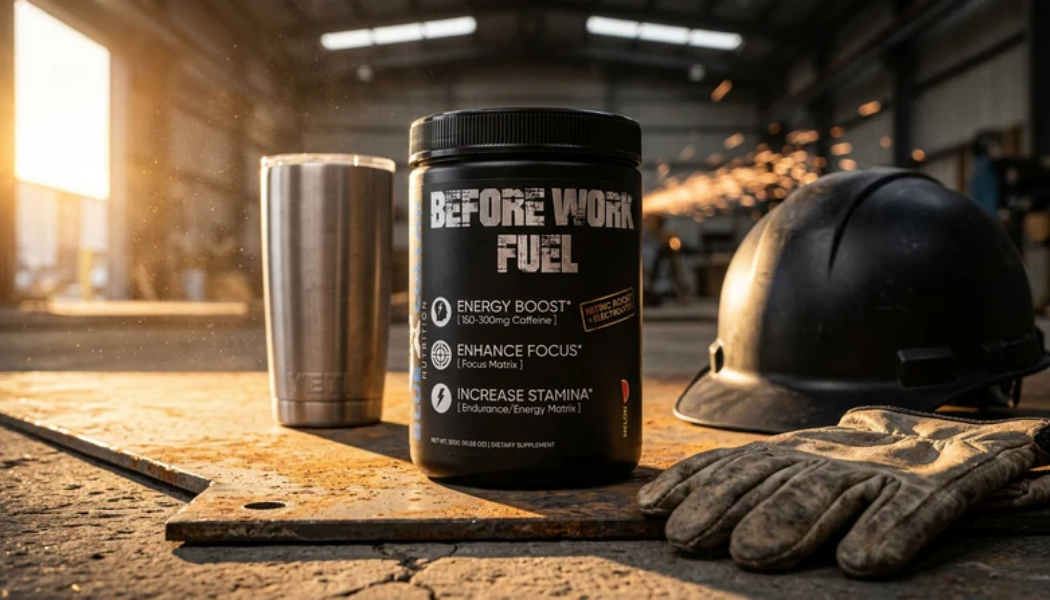
This is the format Before Work Fuel was built around, and the reason it anchors the BCN Energy collection.
What's in Before Work Fuel
Six ingredient categories do the work, and every dose is listed on the panel:
Caffeine (150mg per scoop). The primary energy driver. 150mg is roughly two strong cups of black coffee — enough to start the shift sharp without crossing into jittery territory. Workers with higher tolerance can take two scoops for 300mg total.
B-Vitamin Complex. B1, B2, B3, B6, B12, folate, and pantothenic acid. These are the vitamins your body uses to convert food into usable cellular energy. Low B12 is one of the most common drivers of chronic fatigue.
Focus Matrix (L-Tyrosine + Taurine). Two amino acids studied for their role in supporting alertness, focus, and mental sharpness during long, demanding hours.
Dicreatine Malate (1,500mg). The same family of creatine that supports ATP regeneration and muscular endurance. Helps fight the heavy-limb feeling in the back half of a long shift.
AAKG / L-Arginine Alpha-Ketoglutarate (1,500mg). Supports nitric oxide production and blood flow — meaning more oxygen delivery to working muscles.
Electrolytes (Sodium + Potassium). 80mg sodium and 75mg potassium per scoop. Real electrolytes built into the formula so you're ahead of the dehydration curve before the shift starts.
What you won't find: sugar, artificial colors, hormones, banned stimulants, or filler ingredients pretending to be active.
Before Work Fuel vs. Coffee vs. Canned Energy Drinks
| Before Work Fuel | Coffee | Canned Energy Drinks | |
|---|---|---|---|
| Caffeine | 150–300mg per drink | 80–100mg per cup | 150–300mg per can |
| Sugar | None | None (black) | 40–55g typical |
| Cost per drink | ~$1.66 | $0.10 home / $5 cafe | $4–6 |
| Annual cost (5x/week) | ~$430 | $26 home / $1,300 cafe | $1,040–1,560 |
| Crash | No | Mild | Yes (sugar-driven) |
| Long-lasting energy | Yes | Short | Short |
| Focus support | Strong (amino acids) | Mild | Minimal |
| Electrolytes | Yes (80mg Na, 75mg K) | No | Sometimes (low dose) |
| Daily-use safety profile | Third-party tested | N/A | Mixed |
The home-brewed coffee cost is the cheapest option on the table — no question. But for the workers buying coffee on the drive in or hitting the gas station cooler, powdered energy is a fraction of the daily cost with more ingredients doing more work.
Built for the work, not the gym
Most energy products on the shelf are aimed at gym-goers chasing a 45-minute pump, or at office workers trying to push through one more email. Before Work Fuel is built for the people who use their body and their attention to earn a paycheck:
- Construction workers, framers, and concrete crews
- Welders, electricians, plumbers, and HVAC techs
- Diesel mechanics and heavy equipment operators
- Oilfield, pipeline, and utility workers
- Long-haul truckers and OTR drivers
- Delivery drivers and route drivers
- Military, law enforcement, and corrections
- Warehouse, manufacturing, and logistics workers
- Anyone working 10s, 12s, graveyards, or split shifts
The formula was built specifically for that work — sustained energy across a long physical day, not a 45-minute window.
How to actually use it
The simple version: mix it cold, drink it before the shift, stay on water through the day.
- Mix: 1–2 scoops with 8–16 oz of cold water. Shake or stir until dissolved.
- Timing: 15–30 minutes before the shift starts.
- Tolerance: New to Before Work Fuel? Start with one scoop. Once you know how it hits, you can scale to two on heavier days.
- Hydration: Drink water steadily through the day. For long shifts in the heat, pair Before Work Fuel with Hydrate for the back half of the day.
If you want the full clock-in to clock-out system, the Overtime Pack bundles Before Work Fuel with Refuel for $74.97 — and your first purchase comes with free gifts on top.
For more on what to drink specifically before a pre-dawn shift, see the best early morning energy drink for blue collar workers. For workers regularly running 10s and 12s, the deeper read on sustained energy across the day lives in the best energy supplements for long workdays guide.
Frequently Asked Questions
What is the best energy drink for work?
The best energy drink for work is one built specifically for long physical shifts rather than gym workouts or short bursts of energy. That means a moderate caffeine dose (150–300mg, not 400mg+), zero sugar, real electrolytes for hydration, and clean ingredients listed in real doses on the panel. Powdered energy drinks like Before Work Fuel work better than canned options for daily use because they're cheaper per drink, give you dose control, and include supporting ingredients (B vitamins, amino acids, electrolytes) that canned drinks usually skip.
Do energy drinks make you crash?
Most canned energy drinks cause crashes, and the cause is almost always sugar — not caffeine. A typical 16oz can contains 40–55 grams of sugar, which spikes your blood glucose fast and triggers an insulin response that drops it just as fast. That drop is the mid-morning wall. Caffeine alone has a much milder taper. Energy products with zero sugar — like powdered energy drinks — remove the crash mechanism entirely. The caffeine still wears off eventually, but without the sharp blood sugar drop, the descent is gradual rather than a wall.
Does Red Bull make you crash?
Red Bull contains 80mg of caffeine and 27 grams of sugar in an 8.4oz can — moderate caffeine, but enough sugar to trigger a blood sugar spike and drop in most people. The crash people report after Red Bull is largely sugar-driven rather than caffeine-driven, which is why the bigger 16oz Red Bull cans (with 54 grams of sugar) tend to produce stronger crashes than the smaller original cans. Sugar-free alternatives reduce the crash effect, but for daily-use, a zero-sugar option like a powdered energy drink removes the mechanism altogether.
What's the safest energy drink to drink daily?
The safest energy drinks for daily use share four traits: a moderate caffeine dose (150–300mg, not 400mg+), zero sugar, no hidden proprietary blends, and third-party testing. A daily energy product should let you read every ingredient and dose on the panel without guessing what's in it. Hormone-free, no banned stimulants, no questionable amphetamines — those are the baselines. Powdered energy drinks tend to fit this profile better than canned options, partly because the format allows manufacturers to include real doses of vitamins, electrolytes, and amino acids that canned drinks usually skip.
Is it better to drink coffee or an energy drink before work?
For short shifts or moderate workloads, coffee is fine — it's clean, low-calorie, and inexpensive when brewed at home. For long physical shifts, a purpose-built work energy product covers ground coffee can't: B vitamins for cellular energy, amino acids for focus, electrolytes for hydration, and supporting ingredients for the back half of the day. The honest answer is that coffee works for some workers and falls short for others. If you're consistently dragging by mid-shift on coffee alone, the supporting ingredients in a powdered energy drink are usually what's missing.
Can you drink an energy drink every workday?
It depends on what's in it. A high-sugar canned energy drink every workday for years is hard on your blood sugar regulation, dental health, and digestive system. A clean, zero-sugar powdered energy drink with a moderate caffeine dose and real electrolytes is a much more sustainable daily choice — closer to drinking strong coffee with a multivitamin than to drinking a soda. The factors that matter for daily use are sugar content, caffeine dose (staying under 400mg total daily is the standard guideline), and ingredient quality.
The Bottom Line
The best energy drink for work isn't the one with the most caffeine, the loudest can, or the most aggressive marketing. It's the one that gets you through the full shift without spiking you, crashing you, or wrecking your gut over the years.
For blue collar workers, that means moderate caffeine, zero sugar, real electrolytes, and clean ingredients you can read on the panel. It also means saving four bucks a drink compared to the gas station cooler.
Try Before Work Fuel — 30 servings per container in Blue Raspberry, Melon, and Fruit Punch. Third-party tested, hormone-free, made in the USA, and backed by a 100% money-back guarantee.