Free Hydrate On Orders $99+ USE CODE: HYDRATE

Free Hydrate On Orders $99+ USE CODE: HYDRATE

How Much Fish Oil Should You Take Per Day? A Dosage Guide
June 04, 2026 5 min read
One of the most common questions about fish oil is also one of the most confusing: how much should you actually take? The labels don't help much — a "1,000 mg fish oil" softgel might only contain a few hundred milligrams of the part that matters. Here's a straight answer on daily dosage, what number to actually read on the label, and how much is too much.
How much fish oil should you take per day?
For general adult health, most guidance points to 250 to 500 mg of combined EPA and DHA per day — not 250 to 500 mg of "fish oil." That's the key distinction: the dose that matters is the EPA + DHA number, not the total fish oil weight on the front of the bottle. Many people taking fish oil for daily health aim a bit higher than the minimum, in the 500 to 1,000 mg EPA + DHA range, which is where a single high-potency softgel lands.
One softgel of Omega delivers 720 mg of omega-3 (432 mg EPA + 288 mg DHA) — a real daily dose that clears the general-health floor in one swallow, rather than the token 100 to 200 mg in most grocery-store fish oil.
How many milligrams of fish oil per day?
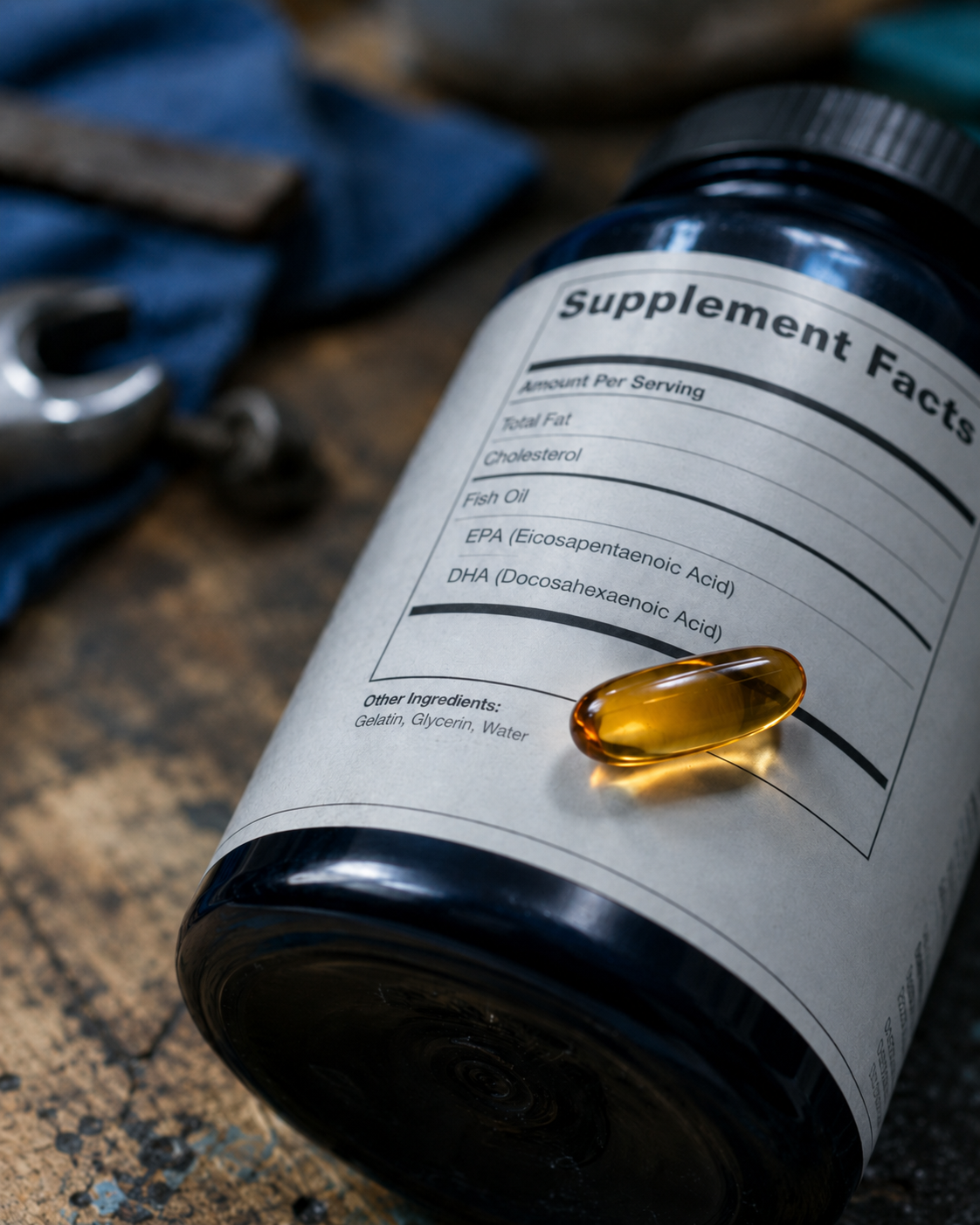
Read the EPA and DHA line, not the "fish oil" line. A softgel labeled "1,200 mg fish oil" might contain anywhere from 300 mg to 900 mg of actual omega-3 depending on its concentration — so two products with the same "fish oil" number can deliver wildly different doses.
Here's how to check any bottle in about ten seconds: find EPA and DHA on the supplement facts panel, add them together, and that's your real daily omega-3 dose. If a label only lists "fish oil" or "omega-3 blend" without breaking out EPA and DHA, that's usually a sign of a low-concentration product hiding a small real dose behind a big total number. Omega lists it plainly: 720 mg total omega-3, broken out as 432 mg EPA and 288 mg DHA, at a 60% concentration.
How many fish oil softgels should you take a day?
That depends entirely on how concentrated the softgel is — which is exactly why the count on the bottle tells you nothing without the EPA + DHA number. A low-potency softgel at 150 mg omega-3 might need three or four a day to reach a meaningful dose; a high-potency one can get you there in one.
With Omega, it's one softgel a day. At 720 mg of omega-3 per softgel, a single one covers the daily general-health range, so there's no need to choke down a handful. One swallow with a meal and you're done — which also makes it a habit you'll actually keep.
What's the recommended fish oil dosage for adults?
For healthy adults, general-health guidance lands around 250 to 500 mg of EPA + DHA daily as a baseline, and the FDA considers up to 3,000 mg of EPA + DHA per day generally safe for most healthy adults. That's a wide window, and where you sit in it depends on your diet and your goals.
The biggest factor is how much fatty fish you eat. The American Heart Association suggests two servings of fatty fish per week to hit baseline omega-3 needs — and if you're eating on the move through long shifts, hitting that with food alone usually isn't realistic. That diet gap is the main reason a daily softgel makes sense. For the right amount for your specific situation, especially if you have a health condition or take medication, talk to your doctor.
Can you take too much fish oil?
Yes — more isn't better past a point, and very high doses come with downsides. The FDA's general-safety ceiling for healthy adults is around 3,000 mg of EPA + DHA per day, and most people have no reason to get near it. Pushing well past that can cause loose stools, stomach upset, and a mild blood-thinning effect.
That blood-thinning effect is the one worth flagging: if you take blood thinners (warfarin, aspirin, clopidogrel), are scheduled for surgery, or have a bleeding disorder, talk to your doctor before adding fish oil — at any dose. For a healthy adult taking one high-potency softgel a day, none of this is a concern; you're nowhere near the ceiling.
Is fish oil worth taking every day?
For most people who don't eat fatty fish regularly, yes — a daily omega-3 is one of the better-supported foundation supplements, and the benefit comes from consistency, not from any single big dose. Omega-3 builds up in your body's tissue over weeks, so a moderate dose taken every day does far more than a large dose taken occasionally.
The honest exception: if you already eat salmon, mackerel, sardines, or anchovies two or more times a week, you may already be getting enough and a supplement adds less. For everyone else — which is most working people eating on the go — a daily softgel is the simplest way to close the gap. If you're wondering about the best moment to take it, our guide on the best time to take fish oil covers timing and stacking.
The bottom line on fish oil dosage
Read the EPA + DHA number, not the "fish oil" number. Aim for the general-health range of 250 to 1,000 mg of combined EPA and DHA a day, stay well under the 3,000 mg ceiling, and take it consistently with a meal. A single high-potency softgel handles all of that without the guesswork.
One softgel of Omega a day delivers 720 mg of omega-3 (432 mg EPA + 288 mg DHA) from clean anchovy-sourced fish oil — third-party tested and made in an FDA-registered facility in the USA.
Frequently Asked Questions
How much fish oil should I take per day?
For general adult health, aim for 250 to 500 mg of combined EPA and DHA daily as a baseline, with many people taking 500 to 1,000 mg. The number that matters is EPA + DHA, not the total "fish oil" figure on the label. One softgel of Omega provides 720 mg of omega-3 (432 mg EPA + 288 mg DHA).
How many milligrams of fish oil per day?
Read the EPA and DHA numbers on the supplement facts panel and add them together — that's your real daily omega-3 dose. A "1,000 mg fish oil" softgel may contain only a few hundred milligrams of actual omega-3, so the total fish oil number alone is misleading.
How many fish oil softgels should I take a day?
It depends on the concentration. A low-potency softgel might require three or four to reach a meaningful dose; a high-potency one can do it in a single softgel. Omega is one softgel a day at 720 mg of omega-3.
What's the recommended fish oil dosage for adults?
General-health guidance lands around 250 to 500 mg of EPA + DHA daily as a baseline, and the FDA considers up to 3,000 mg per day generally safe for most healthy adults. Where you fall in that range depends on your diet and goals — talk to your doctor for personalized guidance.
Can you take too much fish oil?
Yes. The FDA's general-safety ceiling for healthy adults is around 3,000 mg of EPA + DHA per day. Going well beyond that can cause loose stools, stomach upset, and a mild blood-thinning effect. People on blood thinners or scheduled for surgery should talk to a doctor before taking fish oil at any dose.
Is fish oil worth taking every day?
For most people who don't eat fatty fish two or more times a week, yes. Omega-3 builds up in tissue over weeks, so consistent daily intake matters more than a single large dose. If you already eat plenty of salmon, mackerel, or sardines, you may already be getting enough.