Free Hydrate On Orders $99+ USE CODE: HYDRATE

Free Hydrate On Orders $99+ USE CODE: HYDRATE

Digestive Enzymes for Bloating: How They Work and What Actually Helps
July 08, 2025 11 min read
Digestive Enzymes for Bloating: How They Work and What Actually Helps
Bloating after meals is one of those problems most people decide to live with. Belt feels tight after lunch. Heavy and tired by 3 PM. Gas during the drive home. Stomach discomfort by the end of a 12-hour shift. For physical workers who eat on the go — gas station breakfast, drive-thru lunch, whatever's fast at dinner — the cycle is so consistent that it starts to feel normal.
It's not normal. It's usually a digestion problem with a specific cause, and one of the better-studied ways to address it is with the right digestive enzymes.
This guide covers what bloating actually is, why it happens after the kinds of meals workers actually eat, how digestive enzymes work, and what to look for in a quality supplement if you want to stop spending the second half of every shift feeling weighed down.
What Causes Bloating After Meals?
Most people use "bloating" loosely to describe any uncomfortable feeling after eating, but it's actually a specific thing. Bloating is the sensation or visible appearance of a swollen, full abdomen, usually caused by gas accumulation in the digestive tract or by slowed digestion that leaves food sitting longer than it should.
For most healthy adults, bloating after meals comes from one of four sources:
Complex carbohydrates from beans, vegetables, and high-fiber foods. Foods like beans, broccoli, cabbage, onions, garlic, Brussels sprouts, and whole grains contain raffinose, stachyose, and verbascose — sugars the human digestive system can't break down on its own. They reach the large intestine intact, where gut bacteria ferment them and produce gas. This is the most common source of bean-and-vegetable-related gas.
Lactose from dairy and protein supplements. About 65% of adults worldwide have some degree of reduced lactase production, the enzyme needed to break down lactose. Whey protein, milk, cheese, yogurt, and dairy-based protein shakes all contain lactose that goes undigested in lactose-intolerant individuals, causing gas, bloating, and discomfort.
Heavy fats that overwhelm digestion. Fast food, fried food, and rich meals contain more fat than the body's lipase production is built to handle quickly. The fat sits in the stomach longer, creating that heavy, weighed-down feeling that can last for hours.
Large protein loads. Heavy meals with multiple protein sources (a burger plus protein shake plus beef jerky kind of day) can outpace the body's protease production. Undigested protein continues fermenting in the gut, contributing to bloating and gas.
There are other causes — gut motility issues, food intolerances, SIBO, gallbladder problems — and if your bloating is severe, persistent, or accompanied by pain, weight changes, or stool changes, talk to a doctor. But for the standard end-of-shift bloating most workers deal with, the cause is one of the four above, and digestive enzymes can help.
How Digestive Enzymes Work
Your body produces digestive enzymes naturally — saliva contains amylase, the stomach produces protease and pepsin, the pancreas secretes a mix of proteases, lipase, and amylase, and the small intestine produces lactase and other enzymes. For someone eating moderate meals at a relaxed pace, this natural production usually keeps up with demand.
The problem is that most physical workers don't eat moderate meals at a relaxed pace. They eat fast, on the go, during short breaks, and the food itself is heavier and more processed than what the digestive system evolved to handle. When demand exceeds production, you get incomplete digestion — and incomplete digestion is what causes bloating, gas, and that heavy feeling.
A digestive enzyme supplement provides additional enzymes to support what your body is already doing. Each enzyme targets specific food types:
Proteases break down protein. Your body produces several types. Quality supplements add fungal protease (works across a wide pH range), bromelain (extracted from pineapple), and papain (extracted from papaya). Together they support more complete protein breakdown.
Lipase breaks down fats. Most digestive enzyme supplements include fungal lipase, which complements the body's pancreatic lipase by working in the stomach before food reaches the small intestine.
Lactase breaks down lactose, the sugar in dairy. Supplemental lactase is the same enzyme found in over-the-counter products specifically marketed for lactose intolerance.
Alpha Galactosidase breaks down the complex carbohydrates in beans, broccoli, and other fiber-heavy plants. This is the active ingredient in Beano and similar gas-prevention products. It's the most underused enzyme in mainstream digestive supplements, and it's what most fiber-intolerant people are missing.
The right combination depends on what you eat. Someone whose main problem is dairy needs lactase. Someone whose main problem is bean-and-fiber gas needs alpha galactosidase. A worker who eats unpredictably and across all food types needs a comprehensive blend that covers all of the above.
For a deeper breakdown of how each enzyme targets gas specifically, read our digestive enzyme supplements for gas guide.
Do Digestive Enzymes Really Work for Bloating?
Yes, when matched to the right food challenges. The evidence is strongest in three contexts:
Lactose intolerance. Supplemental lactase is one of the most well-supported uses of digestive enzymes. Multiple clinical trials have shown that lactase supplementation significantly reduces gas, bloating, and discomfort in lactose-intolerant individuals consuming dairy.
Bean and high-fiber gas. Alpha galactosidase has been studied specifically for bean-related gas, with consistent positive results. Trials have shown reduced gas production and reduced bloating in people consuming beans, broccoli, and similar foods alongside the enzyme.
Protein and fat overload. The evidence here is less robust but still positive. Bromelain has research for supporting post-meal comfort, partly through its proteolytic effects on protein breakdown.
The honest framing: digestive enzymes don't perform miracles, and they don't help everyone equally. If your bloating comes from gut motility issues, a food sensitivity not addressed by enzyme breakdown, or an underlying medical condition, enzymes won't fix it. If your bloating comes from incomplete digestion of specific food types — which is the case for most physical workers eating on the go — they help significantly within a few days of consistent use.
What to Look For in a Quality Digestive Enzyme Supplement
The digestive enzyme aisle is full of weak formulas with token amounts of enzymes. Here's what actually matters.
Disclosed enzyme activities, not just weights. Enzymes are measured in activity units — HUT (protease), GDU (bromelain), TU (papain), FIP (lipase), LACU (lactase), GALU (alpha galactosidase). A label that lists "500 mg protease" without an activity unit tells you nothing about how much actual enzyme work that ingredient does. A label that says "fungal protease, 2,500 HUT" tells you the formula will actually do something.
A multi-enzyme stack. Single-enzyme products are useful for specific problems (lactase-only for lactose intolerance, for example), but most workers benefit from a comprehensive formula that covers multiple food types. Look for at least 4 to 6 different enzymes.
Alpha galactosidase included. This is the most-overlooked enzyme in mainstream supplements and the one that addresses the most common form of fiber-and-bean-related gas. If a product doesn't include it, it's either marketing to a different problem or cutting costs.
Fungal-source enzymes for digestive flexibility. Enzymes from fungal sources (Aspergillus oryzae, in most cases) work across a wider pH range than animal-source enzymes, meaning they're effective in both the acidic stomach environment and the more alkaline small intestine. Animal-source enzymes are often pH-sensitive and only work in part of the digestive tract.
Vegetarian capsules and clean other ingredients. Veggie capsules (cellulose-based) are standard now. Look for minimal fillers and binders.
Made in the USA, third-party tested. Same baseline as any quality supplement.
When Should You Take Digestive Enzymes?
The standard guidance is to take digestive enzymes 20 to 30 minutes before a meal. This timing lets the enzymes reach your stomach and small intestine ahead of the food, ready to start breaking it down as it arrives.
In practice, most working adults aren't planning meals 30 minutes ahead. The good news is that digestive enzymes still work when taken with the first bite of a meal — the timing is less strict than the label suggests. Take them ahead when you can. Take them with the first bite when you can't. Either way works.
The dose schedule depends on the formula. Most quality supplements call for 1 capsule with each major meal, or 2 to 3 capsules per day total. If you eat 4 or 5 small meals throughout a long shift, take the supplement with the heaviest two — your largest sit-down meal and whatever heavy convenience meal you eat in the truck.
Don't take more than the label recommends. More enzymes don't produce dramatically better results, and at very high doses, some people experience digestive upset.
Digestive Enzymes vs Probiotics
A common question is whether to take digestive enzymes, probiotics, or both. The short answer is both, because they do different things.
Digestive enzymes work on the food during a meal. They break down protein, fat, dairy, and complex carbohydrates so your body can absorb the nutrients and you don't end up with undigested food fermenting in your gut. The effect is immediate and meal-specific.
Probiotics work on the gut bacteria population over time. They don't break down food directly. They support the long-term health and balance of the trillions of bacteria living in your digestive tract, which influences digestion, immunity, and gut barrier function. The effect is gradual and ongoing.
Quality formulas combine both because they address different problems with the same goal — better digestion. Biotics is BCN's daily probiotic — 60 billion CFU across four clinically studied strains with MAKTREK® Bi-Pass Technology. For a side-by-side breakdown of how the two compare, read our digestive enzymes vs probiotics guide. For more on what makes a quality probiotic, read our complete probiotic guide.
Side Effects and Who Shouldn't Take Digestive Enzymes
Digestive enzymes are generally well-tolerated. The most common side effects are mild and dose-related — occasional digestive upset at high doses, mild nausea on an empty stomach, and rare reports of headaches.
The interactions to know about:
Pineapple and papaya allergies. Bromelain comes from pineapple and papain comes from papaya. People with allergies to either fruit should avoid supplements containing these enzymes.
Blood thinners. Bromelain has mild blood-thinning effects and can interact with anticoagulant medications like warfarin and aspirin. People on blood thinners should consult their doctor before starting.
Severely immunocompromised individuals. Probiotic supplements (when included with enzymes) aren't recommended for people with severe immune compromise without medical supervision.
Active GI conditions. Anyone with an active gastrointestinal condition under treatment should talk to their doctor before adding any supplement.
For most healthy adults eating on-the-go meals, digestive enzymes have one of the cleaner safety profiles in the supplement world.
What Workers Get Wrong About Bloating
A few common mistakes worth flagging.
Treating bloating as a fat-loss problem. A lot of what people complain about as "weight" isn't fat — it's bloating from poor digestion. A flatter stomach often comes from better digestion, not from cutting calories further. Workers who go on aggressive diets to deal with their post-meal bloat are usually solving the wrong problem.
Cutting fiber to reduce gas. Fiber is one of the most important nutrients for long-term gut health and metabolic function. Cutting it to reduce gas is a short-term fix that creates worse problems over time. Alpha galactosidase lets you keep eating beans, broccoli, and high-fiber foods without the gas penalty.
Drinking less water. Some people associate bloating with fluid retention and drink less water. This usually makes digestion worse, not better. Adequate hydration is essential for enzyme function and gut motility.
Skipping meals. Workers who get bloated after lunch sometimes skip dinner, hoping to recover. This typically backfires — the missed meal often results in a much larger meal later, which causes worse bloating. Smaller, more consistent meals with enzyme support work better than meal-skipping.
Not eating slowly when you can. Most workers can't eat slowly during shifts. But on the days when you can — weekends, slow days, days off — eating at a slower pace and chewing more thoroughly significantly reduces bloating compared to inhaling food in 8 minutes. Make the slow meals count.
Going enzyme-only when probiotics would help. Acute meal-time bloating is an enzyme problem. Chronic, daily, every-meal bloating is more often a microbiome problem that benefits from a daily probiotic like Biotics alongside meal-time enzymes. For details on the gut-energy connection that probiotics affect, read our guide on why your gut quietly drives your daily energy.
Where Digest Fits
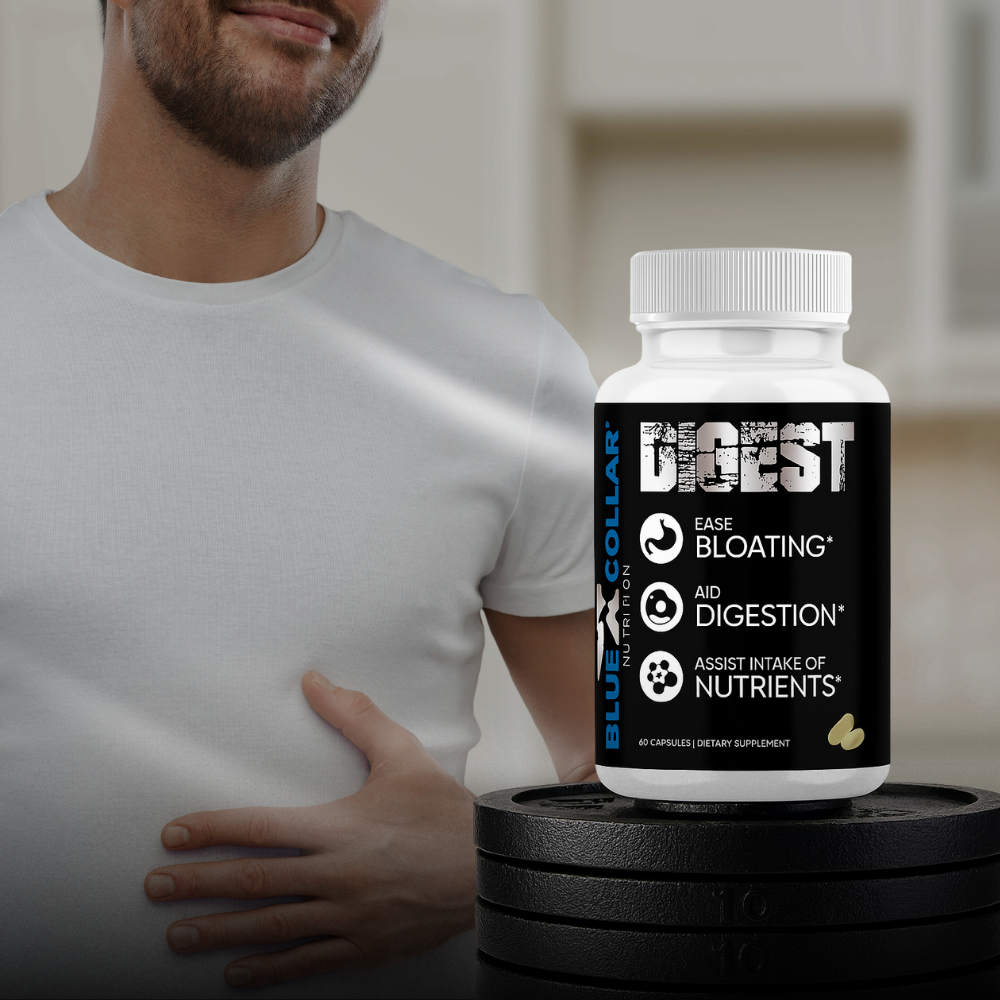
Blue Collar Nutrition makes Digest, a digestive enzyme supplement designed specifically for workers who eat on the go. The formula combines six digestive enzymes plus Alpha Galactosidase in a single veggie capsule:
- Fungal Protease (Aspergillus oryzae) — protein support across a wide pH range
- Bromelain (90 GDU) — pineapple-derived protease for protein and post-meal comfort
- Papain (2,670 TU) — papaya-derived protease, complementary to Bromelain
- Fungal Lipase (1,500 FIP) — fat digestion support
- Fungal Lactase (600 LACU) — dairy and lactose support
- Alpha Galactosidase (300 GALU) — the gas-and-bloat fighter for beans, broccoli, cabbage, and other high-fiber foods
The Alpha Galactosidase is the part most people don't know to look for. It's what targets the bean-and-fiber gas that most digestive supplements ignore. Combined with Bromelain and Papain for protein, Fungal Lipase for fat, and Fungal Lactase for dairy, Digest is built to handle the food workers actually eat — fast food, gas station meals, protein shakes, dairy, heavy dinners — instead of the ideal balanced meal supplement labels usually picture.
Take 1 capsule twice a day with meals. For best results, 20 to 30 minutes before the meal. With the first bite still works if you can't plan ahead.
For long-term gut microbiome support that pairs with meal-time enzyme use, Biotics is the daily probiotic companion. The Gut Pack bundles Biotics and Digest at a $13 discount for the full daily and meal-time gut system.
Frequently Asked Questions
Do digestive enzymes help with bloating?
Yes, when matched to the food causing the bloating. Lactase supports lactose digestion and reduces dairy-related bloating. Alpha galactosidase targets the complex carbohydrates in beans and high-fiber vegetables. Bromelain and papain support protein breakdown and post-meal comfort. The right enzyme stack addresses the specific food types causing your discomfort.
How long do digestive enzymes take to work?
Digestive enzymes start working within minutes of taking them. The bloating reduction is typically noticeable within the first few meals of consistent use. Unlike probiotics, which build up over weeks, enzymes have an immediate effect on the meal you take them with.
Can I take digestive enzymes every day?
Yes. Digestive enzymes are safe for daily use at recommended doses. Many people take them with every meal long-term without any issues. They don't build tolerance the way stimulant supplements do, and your body doesn't reduce its own enzyme production in response to supplementation.
Are digestive enzymes safe?
For most healthy adults, yes. Digestive enzymes are well-tolerated and have a clean safety profile. The exceptions are people with allergies to pineapple (bromelain) or papaya (papain), people on blood-thinning medications (bromelain interaction), and severely immunocompromised individuals (if probiotics are included). Always check with your doctor if you have any medical condition or take prescription medications.
Can digestive enzymes help with fast food?
Yes. Fast food typically combines high fat, processed protein, and refined carbohydrates — exactly the food types digestive enzymes are built to handle. Bromelain, papain, and fungal protease support the protein. Fungal lipase supports the fats. Alpha galactosidase handles any beans, onions, or high-fiber ingredients. A comprehensive enzyme formula taken with fast food significantly reduces post-meal heaviness and bloating.
What's the difference between digestive enzymes and probiotics?
Digestive enzymes break down food during a meal — protein, fat, dairy, and complex carbohydrates. Probiotics are live bacteria that support the long-term balance of your gut microbiome. They work on different parts of digestion and complement each other. The best approach for most people combines both — enzymes for meal-time and a daily probiotic like Biotics for gut foundation. For a deeper comparison, read our digestive enzymes vs probiotics guide.
Will digestive enzymes help me lose weight?
Not directly. Digestive enzymes don't burn fat or affect metabolism. What they can do is reduce the bloating that often gets mistaken for weight gain, and improve nutrient absorption from the food you're eating. For workers in a fat-loss phase, better digestion supports the appearance of a flatter stomach and supports the absorption of protein and other nutrients critical during a calorie deficit.
When should I take digestive enzymes?
Take 1 capsule 20 to 30 minutes before a meal for best results. If you forget or don't have time to plan, taking it with the first bite of your meal still works. The enzymes start working as soon as they hit your stomach.
Who shouldn't take digestive enzymes?
People under 18 without medical guidance, pregnant or nursing women without consulting their doctor, anyone with allergies to pineapple or papaya, anyone on blood-thinning medications without doctor consultation, severely immunocompromised individuals (when probiotics are included), and anyone with an active GI condition under treatment. If you have any medical condition or take prescription medication, talk to your doctor before starting.
These statements have not been evaluated by the Food and Drug Administration. This product is not intended to diagnose, treat, cure, or prevent any disease.